
// OpenBIM / IFC
Preparing an IFC model by use case: the Simplebim approach
Published on 24 March 2026 · 6 min read · CADatWORK Learning
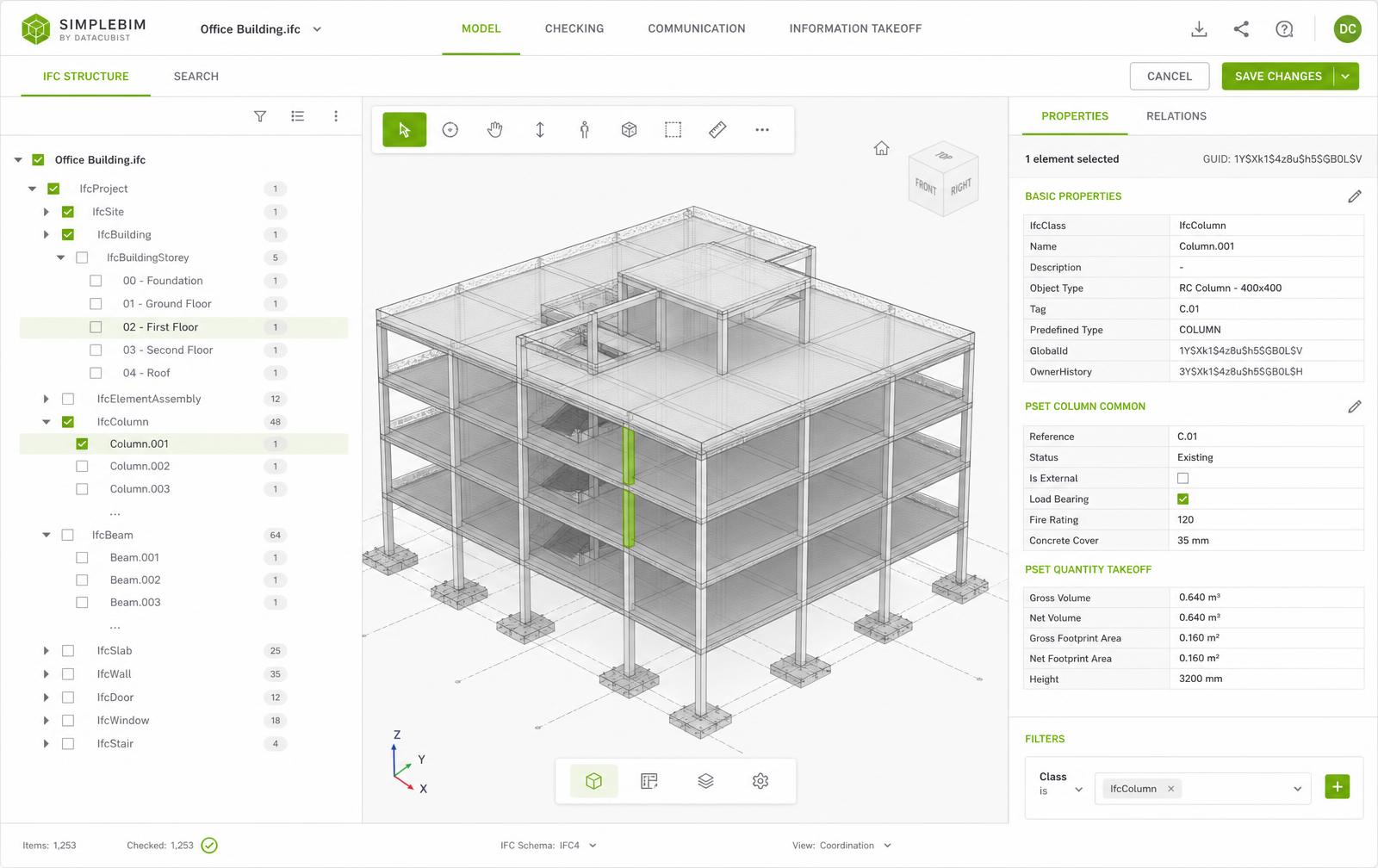
Sending the full design model to a quantity surveyor, an operator or a contractor amounts to handing them an unfiltered database. Each will have to do a sorting job they aren't supposed to do — and will do it differently.
Preparation by use case means producing, from the same source model, reduced and enriched deliverables for a specific recipient.
Filter before enriching
The first operation is subtractive: only the objects useful to the targeted use are kept, with only the necessary properties. A lighter deliverable is faster to check, simpler to understand and far less ambiguous.
Restructure the properties
Properties coming out of a design tool carry that tool's logic, not the recipient's. Renaming, grouping, converting and completing them into a consistent set is what makes the file truly usable downstream.
This work is done on the IFC, without going back into the native model: the modeller isn't interrupted and the design model stays intact.
Make preparation repeatable
The value of the approach comes from its repeatability. By capitalising the filtering and enrichment rules into a preparation template, every new version of the source model produces the same deliverable, with the same rules — therefore comparable to the previous one.
- A preparation template by use case and by recipient
- A completeness check run before every distribution
- A deliverable name carrying the use case, version and date
What preparation doesn't fix
Data missing from the source model cannot be invented at preparation stage. If a property is structurally missing, the fix belongs in the design template or the export settings: preparation simply reveals the gap.
Key takeaways
- A deliverable is defined by its recipient and use case, not by the design model.
- Filter first, enrich afterwards.
- Capitalising the rules makes successive deliveries comparable.
- Data missing at the source is fixed at the source.
Go further
A project, a question?
Our interventions are built on your production context.
Contact us