
// Outlook
Policy and outlook for European architecture through 2045
Published on 1 August 2026 · 7 min read · CADatWORK Learning
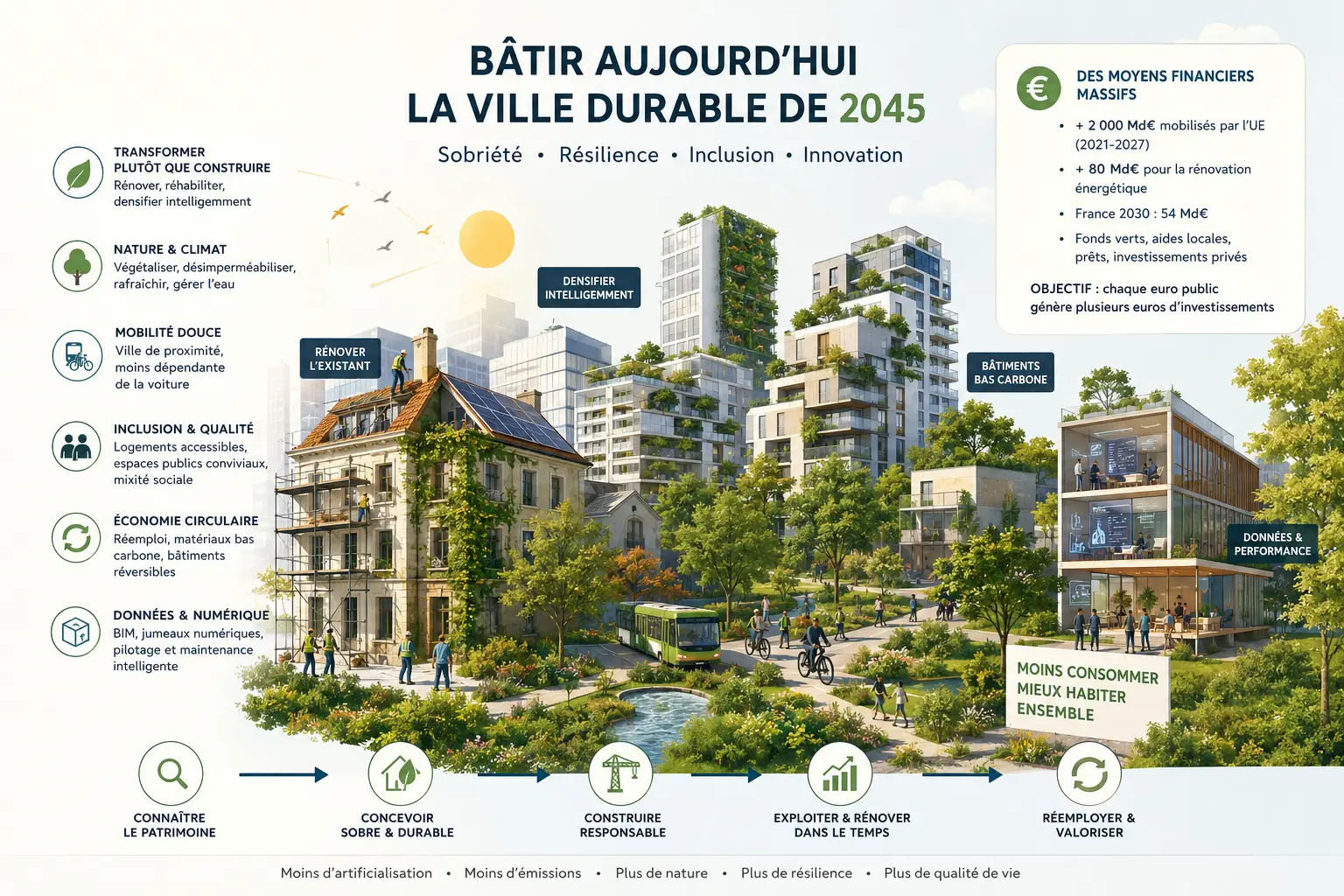
The construction sector is entering a period of unprecedented change. Unlike previous regulatory shifts, this is no longer just about improving the energy performance of buildings or tightening a handful of technical requirements. France and the European Union are now pursuing a genuine societal vision in which the built environment becomes a major lever for the ecological transition, climate resilience, digital transformation and quality of life.
By 2045, this vision will durably reshape the practices of architects, consulting engineers, construction economists, building companies, local authorities and property managers.
The sector's biggest transformation in fifty years
The question is therefore no longer "How do we build more?" but "How do we sustainably transform what already exists?"
A new way of designing the city
For more than half a century, European urban development has relied mainly on urban sprawl, the creation of new districts, out-of-town retail zones and heavy consumption of natural and agricultural land.
This model is now reaching its limits.
French and European public policies are now converging on a shared goal: a more frugal, more resilient and higher-quality city.
This shift rests on several key principles:
Tomorrow's architecture will no longer be solely an architecture of creation. It will become an architecture of transformation.
- limiting land take through the Net Zero Land Take policy (ZAN);
- prioritising the renovation and transformation of existing heritage;
- intelligently densifying already urbanised areas;
- developing a greener city adapted to climate change;
- encouraging short-distance mobility;
- reducing the building sector's carbon emissions;
- embedding circular-economy principles across the whole construction chain.
Existing building stock becomes construction's primary resource
One of the most profound changes concerns the way we approach the existing building stock.
For a long time, when a building no longer suited its purpose, demolition followed by reconstruction was the preferred solution.
Tomorrow, that logic will be reversed.
Before any demolition, professionals will need to ask themselves:
This approach fundamentally changes the role of architects, engineers, economists and companies.
The real challenge will no longer be solely to build a high-performing structure, but to extend the value of existing heritage for decades to come.
- Can the building be refurbished?
- Can its use be changed?
- Can it be extended upward?
- Can its energy performance be improved?
- Can its service life be extended?
- Which materials can be reused?
Climate adaptation becomes a design criterion
Climate change is no longer seen as a future risk but as an already observable reality.
Projects will now need to factor in:
Buildings will need to stay comfortable while consuming less energy.
Bioclimatic design, solar shading, natural ventilation, high-thermal-mass materials, greened spaces and soil de-sealing will gradually become standard practice.
- heatwave episodes;
- droughts;
- flood risks;
- urban heat islands;
- stormwater management;
- biodiversity;
- infrastructure resilience.
The building becomes a bank of materials
Another revolution is already underway: the circular economy.
Future buildings will need to be designed to be:
Every building component will increasingly be seen as a resource that can be reused in a future project.
This shift will substantially increase the need for material traceability and technical data management.
- repairable;
- adaptable;
- demountable;
- recyclable;
- reusable.
Data becomes construction's new material
Digital technology is probably the common thread running through this entire transformation.
BIM, digital models, open IFC formats and digital twins are no longer just design tools.
They are becoming the backbone of property asset management.
Data will, in particular, make it possible to:
In this context, the quality of IFC data becomes a strategic issue.
Reliable data is now an asset in its own right, on a par with the building itself.
- analyse project quality;
- check regulatory compliance;
- assess environmental performance;
- prepare renovations;
- track maintenance operations;
- improve building operation;
- measure carbon indicators;
- steer investment decisions over several decades.
A policy backed by substantial public investment
This transformation does not rest on regulation alone.
It is accompanied by an exceptional financial effort mobilising European institutions, the French State, local authorities and public financial institutions.
The 2021-2027 European budget framework, supplemented by the NextGenerationEU plan, represents more than €2,000 billion in financial commitments.
A significant share of this investment directly or indirectly supports:
In France, several schemes complement this strategy:
The aim is not to fully fund every project.
Public authorities are above all seeking a leverage effect that mobilises large-scale private investment around a shared trajectory for transforming the building stock.
- energy renovation;
- building decarbonisation;
- digital transformation;
- regional revitalisation;
- industrial innovation;
- climate resilience.
- France 2030;
- the Fonds Vert (Green Fund);
- ADEME;
- Banque des Territoires;
- Energy Savings Certificates;
- MaPrimeRénov';
- energy-transition loans;
- European FEDER and FSE funding.
Skills become the key factor for success
The coming years will not only be marked by technological change.
They will above all be defined by an upskilling of the entire industry.
Professionals will need to master:
In other words, value will progressively shift from the simple act of building towards the ability to produce, control and operate reliable data throughout a building's lifecycle.
- BIM methods;
- openBIM;
- IFC formats;
- data analysis;
- energy renovation;
- life-cycle assessment;
- low-carbon materials;
- collaborative processes;
- European regulatory requirements.
What this transformation means for construction professionals
The markets set to grow fastest over the next twenty years include in particular:
For architects, consulting engineers, construction economists and building companies, this represents a major opportunity to broaden their skills and create new high-value services.
- heritage BIM;
- renovation and refurbishment;
- as-built modelling;
- laser surveys and Scan-to-BIM;
- BIM audits;
- IFC data management;
- decision-support dashboards;
- digital quality control;
- digital twins;
- operation and maintenance.
The CADatWORK Learning vision
At CADatWORK Learning, we are convinced that this transition can only succeed by combining three complementary areas of expertise:
mastery of professional software, the structuring of BIM processes, and the valorisation of open data from digital models.
That is why, for several years, we have been supporting construction professionals in:
Our expertise in processing IFC files, our status as Simplebim's exclusive importer in France, and our experience working with organisations of every size allow us to provide concrete support for this transformation towards a more sustainable, smarter and higher-performing built environment.
- their BIM and software training (Archicad, Revit, Simplebim);
- improving their production methods;
- the quality of their digital models;
- leveraging IFC data;
- automating quality checks;
- developing decision-support dashboards;
- preparing future uses of digital heritage.
Preparing today to build tomorrow's value
The transition driven by French and European policy is not a one-off regulatory change.
It sets the roadmap for construction over the next twenty years.
Organisations that invest now in skills, collaborative methods, BIM data quality and interoperability will hold a lasting competitive advantage.
More than ever, the future of construction will rest on a combination of technical know-how, data mastery and the ability to support the transformation of the built environment.
At CADatWORK Learning, we turn this vision into operational reality by helping every construction stakeholder move towards a more open, more reliable BIM that fully serves project performance.
Key takeaways
- their BIM and software training (Archicad, Revit, Simplebim);
- improving their production methods;
- the quality of their digital models;
- leveraging IFC data;
A project, a question?
Our interventions are built on your production context.
Contact us