
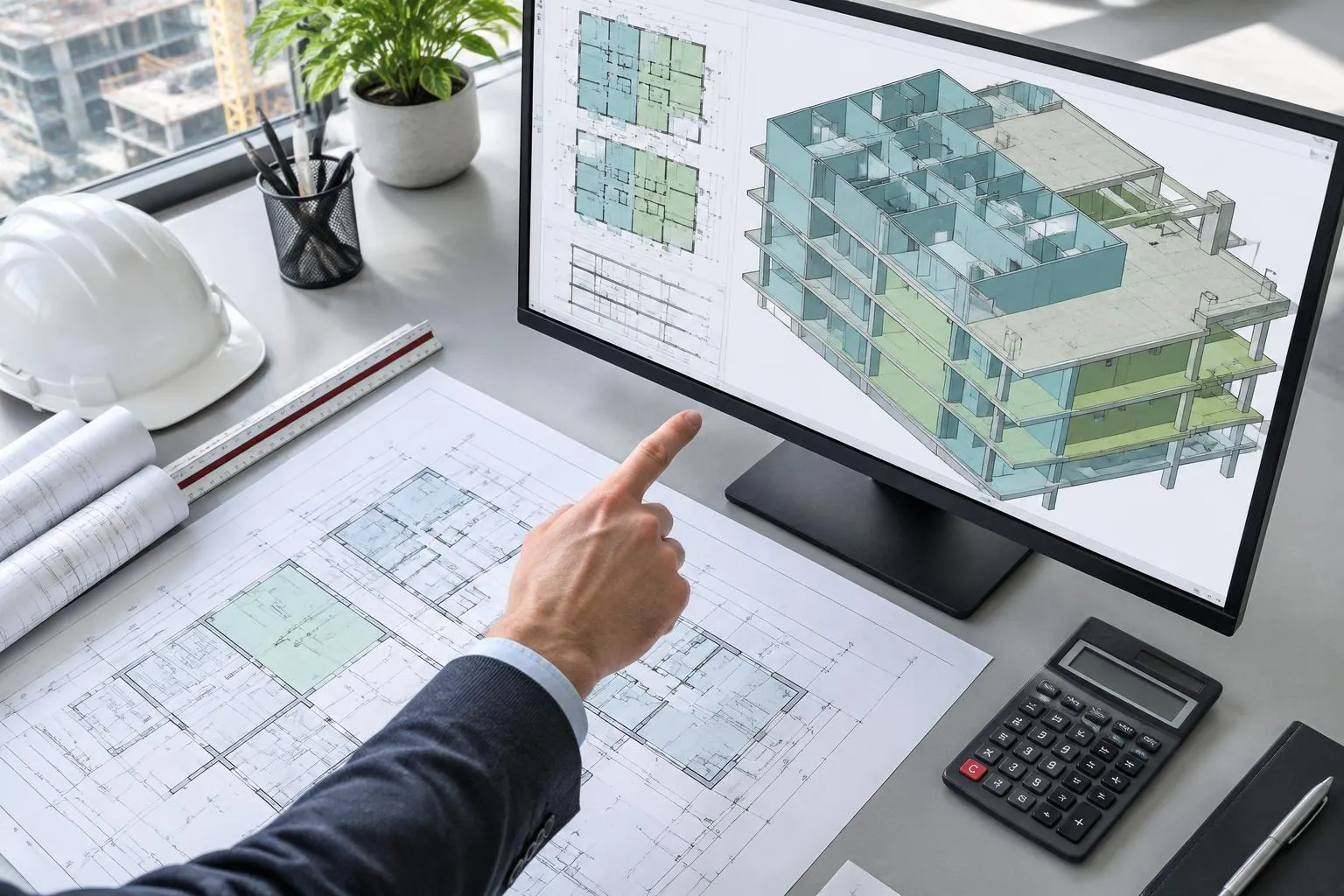
Lessons learned from FlexBIM5D, CADatWORK Learning’s technical partner: how the expertise of a cost consultant (quantity surveyor) reminds us that data quality begins long before artificial intelligence.
From mastering software to mastering methods
On 16 October 2026, we published an initial article entitled “BIM and artificial intelligence: what if our first productivity problem wasn’t technological?”.
In it, we argued that, before routinely turning to artificial intelligence solutions, construction professionals would benefit from making better use of their existing software, structuring their data and improving their processes.
This reflection drew in particular on accounts from an architect specialising in Archicad and a cost consultant who uses Simplebim.
Following that publication, Stéphane Le Roy, a cost consultant and FlexBIM5D technical partner, sent us a complementary analysis based on 35 years of experience in quantity take-offs and cost estimating.
His message builds on our thinking, but introduces an additional requirement: even before choosing tools and automating processing, we must define the business rules those tools are to apply.
This contribution deserves to be shared because it provides a very practical illustration of the financial consequences of poorly controlled automation.
1. The automation trap: 2 correct results can produce an incorrect result
In his experience report, Stéphane Le Roy presents an anonymised real-life case from a pilot project.
2 cost consultants are working on the same project, which includes two plant rooms. They use different BIM models to prepare their quantities.
The first works from the rooms (spaces) in the architectural model.
The second uses the slabs in the structural model.
Both include liquid-applied waterproofing work.
The results are as follows:
Data | Architectural model | Structural model |
|---|---|---|
Waterproofing area | 43 m² | 52,99 m² |
Length of upstands | 37,66 m | 34,78 m |
Calculated amount | 3 355 € | 3 763 € |
Each cost consultant applied a rate build-up consistent with their own interpretation of the model.
Yet the same waterproofing work is counted twice, giving a combined total of 7 118 €.
The problem is not necessarily incorrect use of the software, a formula error or an incorrect quantity extraction. It is much more fundamental: no one had defined beforehand which model should be used to quantify this work.
Should the waterproofing have been measured from the architectural rooms or the structural slabs?
Both approaches could have been valid, provided a common convention was chosen and the scope boundaries were specified.
Without that decision, automation simply reproduced two different interpretations of the same construction work.
This case shows that correctly calculated information is not necessarily correctly used information.
And the more processing is automated, the faster this kind of inconsistency can spread.
2. The real danger: no longer knowing what to check
We emphasised, in our first article, the time needed to check results produced by artificial intelligence.
FlexBIM5D’s account adds another difficulty.
To check a result, you need a reference point.
A cost consultant can check a quantity, a formula, a unit or a price.
But how can they detect that work has been counted in two different rate build-ups if no rule states that it must be allocated to just one?
An AI system working with these data could easily produce a convincing summary.
It can add up amounts, generate a table, draft a specification or present a structured schedule of quantities.
But if nothing tells it that both rate build-ups concern the same work, it lacks the information needed to identify this duplicate reliably.
This is where Stéphane Le Roy’s experience becomes particularly telling:
“Automating without method does not save time. It creates disorder faster — and leaves us no longer knowing what to check.”
This observation extends far beyond quantity take-offs.
It also applies to BIM classifications, IFC checks, schedules, technical specifications (CCTP), priced bills of quantities (DPGF) and, more generally, all processes that turn technical data into financial decisions.
3. Before the first measurement: set out the ground rules
What solution could have prevented this situation?
According to Stéphane Le Roy, a simple approach: formalise working conventions before starting quantity take-offs.
This formalisation must answer four fundamental questions.
Who measures?
Responsibilities must be identified. The professional who models an object is not necessarily the one who should quantify it or prepare its cost estimate.
Under which measurement rule?
A quantity extracted from a model is not always directly a billable quantity.
It may require a formula, coefficients, deductions or specific conventions.
In which unit and within which boundaries?
Gross or net areas, lengths, volumes, deduction thresholds, any wastage, and work included or excluded must all be specified.
Based on which data?
It is essential to identify the reference model, the objects concerned and the information needed for the calculation.
In the approach described by FlexBIM5D, these rules are held in the rate build-up, which brings together the business logic, the objects concerned and the components to be costed.
Classifications, work packages, buildings, phases and statuses are then used to organise different views of the data, without having to reconstruct the calculations for each output.
This organisation has one essential aim: to maintain a consistent, traceable calculation source while allowing the same information to be used in multiple ways.
4. BIM, automation and AI: putting operations in the right order
FlexBIM5D’s feedback leads us to expand on our initial approach.
We had identified the importance of mastering design software, data-processing tools and automation capabilities before introducing AI.
We now propose making a preliminary step explicit: formalising business rules.
This approach can be organised into four phases.
Phase 1 — Define the framework: establish what you want to achieve
Before any automation, professionals must specify the expected deliverables, responsibilities, measurement conventions, scope boundaries and checking rules.
This phase primarily concerns professional expertise and project organisation.
Phase 2 — Check and structure: make the data usable
Design software such as Archicad and Revit produces models and their associated information.
Specialist BIM data-processing tools, including Simplebim, then make it possible to check, filter, enrich and structure IFC information according to the defined requirements.
The issue is not simply having data, but checking that they meet the expectations of professional users.
Phase 3 — Measure and cost: apply the rules reproducibly
Quantities can be extracted, transformed and linked to rate build-ups and prices.
Automated calculations then become particularly valuable: they allow the same conventions to be reproduced across several projects.
But it must remain possible to trace an amount back to the construction work, its quantity, its formula and its source.
An inventory of work included in several rate build-ups is also an important check.
An apparent duplicate is not necessarily an error. It is a point to examine and a decision to make.
Phase 4 — Present the results and bring in artificial intelligence
Once the data are structured and the calculations validated, AI can add further value.
In particular, it can assist with drafting specifications, facilitate cross-checking between documents, suggest summaries and help examine certain potential anomalies.
However, the professional remains responsible for validating the information produced and its technical relevance.
AI is no longer tasked with inventing a structure from uncertain data. It is used to enhance and accelerate a process that is already under control.
5. How these lessons learned change our view of BIM training
At CADatWORK Learning, we help professionals master Archicad, Revit, Simplebim and OpenBIM processes.
Our first article already raised a question: should professionals always be trained in AI when their primary aim is to improve productivity?
FlexBIM5D’s experience reinforces our conviction that we must begin by understanding how they work.
Technical training can teach people to produce a schedule, use IFC properties, apply processing rules or automate extractions. But these skills are not enough if the company has not defined the conventions needed to check the results.
There is therefore value in bringing together 3 complementary dimensions:
Professional expertise, which defines the rules, responsibilities and expected results.
Software and BIM expertise, which enables data to be produced, structured, checked and used.
Automation and AI expertise, which accelerates relevant operations and facilitates certain analyses.
This combination should also guide how training is designed.
Rather than focusing solely on learning software features, it makes sense to work on cases drawn from companies’ actual project work.
This is how training can contribute to lasting process improvements, rather than simply accumulating software skills.
6. FlexBIM5D and CADatWORK: 2 complementary areas of expertise supporting data reliability
These lessons learned also illustrate the value of dialogue between technical partners.
FlexBIM5D’s expertise is based on in-depth knowledge of quantity take-offs, cost estimating and cost tracking using BIM models.
CADatWORK Learning’s approach focuses in particular on software proficiency, IFC interoperability, data processing and professional skills development.
These two perspectives share the same objective: enabling companies to turn their digital models into reliable, usable information.
The IFC format, processing tools such as Simplebim and structured cost-estimating methods can help maintain this continuity between design and construction cost management.
But technical interoperability alone does not guarantee financial consistency.
Data that have been correctly transferred can still be misinterpreted.
This is precisely why professional conventions, checking rules and traceability must accompany digital exchanges.
7. What if AI’s true revolution were to make us define our professions more clearly?
It would be tempting to conclude that artificial intelligence is unsuitable for construction cost management professions.
That would be a misreading of these accounts.
AI offers valuable capabilities to assist professionals. Its potential grows when information is consistent, processes are explicit and results can be checked.
But it also confronts us with a deeper question:
do we understand our own methods well enough to explain them to a machine?
Many professional practices still rely on habits, individual knowledge and decisions that are not always formalised.
This knowledge is a valuable asset, but it becomes difficult to pass on, share and automate when it remains implicit.
When properly implemented, the BIM approach offers precisely the opportunity to structure this collective intelligence.
Artificial intelligence can then make it easier to use.
Digital transformation is therefore not just about making machines work faster. It is also about making our methods more explicit, our data more reliable and our decisions easier to understand.
Conclusion — Before AI, method.
Before automation, the business rule.
The experience shared by Stéphane Le Roy and FlexBIM5D adds a further conclusion to our first article.
We argued that we needed to make better use of our tools before asking AI to do everything.
We can now go further:
even before using these tools, we need to know precisely what we want to ask them to do and how we will check their results.
Productivity is not measured solely by the time saved on an operation.
It is also measured by the reliability of information, risk control, the ability to reproduce results and the confidence professionals can place in the documents produced.
Effective automation is not automation that eliminates all human involvement.
It is automation that allows professionals to spend more time on what truly makes them valuable: understanding, analysing, deciding and taking responsibility for their choices.
Our shared conviction:
- method defines,
- BIM structures,
- automation executes,
- AI assists
- and the professional validates.
About this contribution
This article builds on our publication of 16 October 2026 on BIM, artificial intelligence and productivity.
It draws on the experience shared by Stéphane Le Roy, a cost consultant and FlexBIM5D technical partner, based on an anonymised real-life case of construction cost tracking using a BIM model.
We thank him for this contribution, which enriches our thinking on methods, skills and digital tools.
CADatWORK Learning helps construction professionals master Archicad, Revit, Simplebim, IFC data and BIM processes.
Key takeaways
Method defines, BIM structures, automation executes, AI assists and the professional validates.
Define the reference model and scope boundaries before quantity take-offs.
Maintain traceability from the amount back to the quantity, formula and source.
An apparent duplicate must be examined: it is not necessarily an error.